
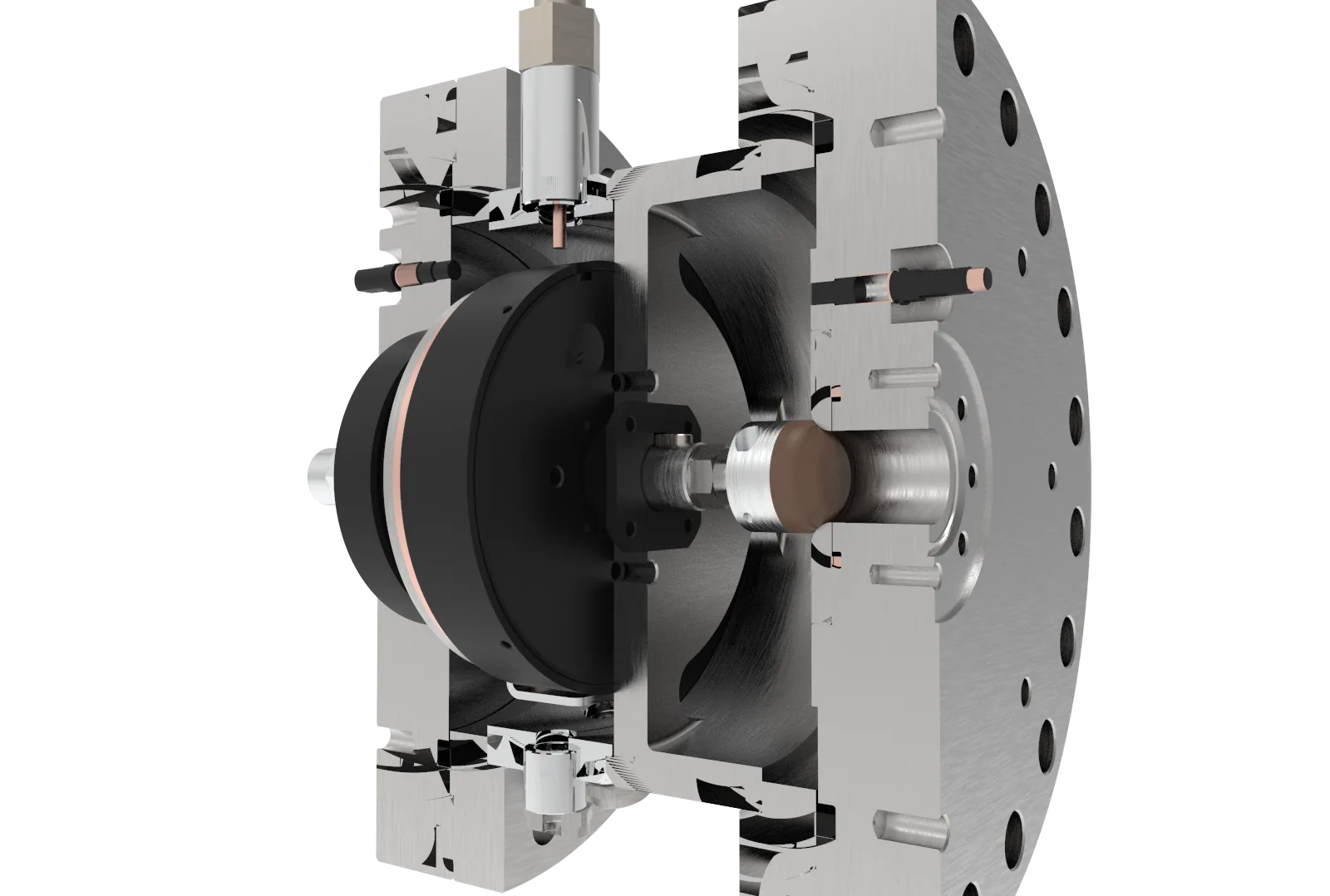
High-speed electromagnetic actuator technologies for precise and demanding fusion applications.
Ultra-fast electromagnetic actuator technologies developed for demanding fusion applications.
Many systems in a fusion device must react on extremely short timescales. Conventional mechanical actuators are often too slow for these applications, especially when a component must move within only a few milliseconds while maintaining precise and repeatable operation.
At HUN-REN Centre for Energy Research, we develop high-speed electromagnetic actuators, fast valves and shutter technologies for fusion applications. Our research combines electromagnetic design, mechanical engineering, numerical modelling, diagnostics and extensive laboratory testing.
A major application of this work is the ITER Disruption Mitigation System (DMS), where cryogenic pellets are injected into the plasma to mitigate the effects of major plasma disruptions. The pellets are accelerated using high-pressure gas, but part of this propellant gas may travel ahead of the pellet fragments. A fast shutter can therefore be used to rapidly close the flight path after the pellet has passed and reduce the amount of gas reaching the plasma.
ITER DMS Fast Shutter
The Fast Shutter Prototype developed at HUN-REN CER uses an eddy-current-driven electromagnetic actuator for acceleration together with an eddy-current brake for contact-free deceleration.
This combination allows the moving shutter head to accelerate extremely rapidly and then stop without a mechanical impact at the end of its travel.
Laboratory testing demonstrated closure of a 40 mm aperture in approximately 2 milliseconds, compared with closing times of around 10 milliseconds for typical commercially available fast shutters. During the fastest measurements, the moving component reached a velocity of approximately 24 m/s.
Designed for repeatability and lifetime
For a fusion machine, a single successful actuation is not enough. The system must perform the same movement thousands of times while maintaining its timing, sealing capability and mechanical condition.
The prototype therefore underwent extensive cycle testing. More than 12,000 actuation cycles were performed, including more than 10,000 consecutive shots without modification of the mechanical components. The electromagnetic braking system successfully stopped the moving head without mechanical impact throughout the tests.
Closing-time repeatability was also significantly better than the original ITER requirement. After thermal stabilisation, the measured standard deviation was below 8.3 μs, compared with a specified limit of 100 μs.
Modelling and experimental validation
The actuator development is supported by coupled electromagnetic and mechanical simulations. Experimental measurements of position, velocity, electrical current and deceleration were compared with numerical predictions, showing close agreement between the models and the physical prototype.
This validated modelling approach can also be applied to the development of other ultra-fast electromagnetic mechanisms, allowing actuator concepts to be adapted to different forces, travel distances, timing requirements and operating environments.
Current developments also include fast valve technologies for ITER DMS applications, where sub-millisecond opening, high-pressure hydrogen operation, vacuum compatibility and operation in strong magnetic and radiation environments must be considered simultaneously.
Key capabilities
- Ultra-fast electromagnetic actuation
- Eddy-current actuators and brakes
- Millisecond and sub-millisecond mechanisms
- High-speed valve development
- Electromagnetic and mechanical simulation
- Prototype manufacturing and testing
- High-cycle lifetime testing
- Vacuum-compatible designs
- Fusion-relevant magnetic and radiation environments
Selected publication
D. I. Réfy et al. — ITER DMS fast shutter prototype testing
Fusion Engineering and Design, Volume 216, 2025, 115089